Posts

Showing posts with the label Rate

Baud Rate Generator

Image
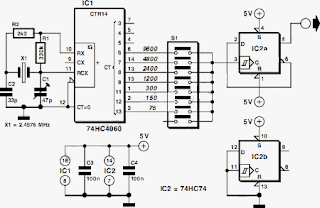
 Baud Rate Generator Circuit Diagram. In this article, an RC oscillator is used as a baud rate generator. If you can calibrate the frequency of such a circuit sufficiently accurately (within a few percent) using a frequency meter, it will work very well. However, it may well drift a bit after some time, and then…. Consequently, here we present a small crystal-controlled oscillator. If you start with a crystal frequency of 2.45765 MHz and divide it by multiples of 2, you can very nicely obtain the well-known baud rates of 9600, 4800, 2400, 600, 300, 150 and 75. If you look closely at this series, you will see that 1200 baud is missing, since divider in the 4060 has no Q10 output!  Baud Rate Generator Circuit Diagram If you do not need 1200 baud, this is not a problem. However, seeing that 1200 baud is used in practice more often than 600 baud, we have put a divide-by-two stage in the circuit after the 4060, in the form of a 74HC74 flip-flop. This yields a similar series of baud ...

Miniature High Rate Speed Control with BEC

Image
How to build a Miniature High-Rate Speed Control with Battery Eliminator Circuit (BEC) . This design is based on one published by Milan Lulic in the German magazine elektroModell. Mr. Lulic’s design is for surface mount technology (SMT) construction, whereas mine uses standard off-the-shelf components, and is therefore better suited to construction by the hobbyist. The circuit begins with a buffer, consisting of C1, R1, and Q1. This provides some isolation between the receiver and the rest of the circuit, and makes circuit operation somewhat independent of the model of receiver (although you may have to adjust R8 if you change receiver types). R2, R3, and C2 form an integrator, which produces an output voltage proportional to the pulse width of the input signal. This output voltage varies from approximately 1.15V for a 1ms input to 1.45V for a 2ms input (at 50 pulses per second). Z1A, together with R4 through R8, and C3, form a 2.5kHz triangle wave generator. R8 adjusts the upper and l...